



Lessons from the 1985 Mexico City Earthquake for Bangkok and Beyond

This year marks the 40th anniversary of the 1985 Mexico City earthquake, a historic event that remains a critical case study in understanding basin amplification and its impact on urban seismic risk. This earthquake’s destructive mechanism provides valuable insights for earthquake engineering and urban disaster mitigation worldwide.
Earlier this year, Bangkok, Thailand, experienced unexpected damage due to basin amplification following the Myanmar earthquake, highlighting the need to learn from history and the experience of Mexico City.
The 1985 Mexico City Earthquake: What happened?
On the early morning of 19 September, 1985, a magnitude (Mw) 8.0 earthquake struck off the pacific coast, over 300 kilometers away from Mexico City’s center. Despite the large distance from the epicenter, Mexico City suffered devastating damage. The Los Angeles Times reported surprising intensity of the ground motion recorded in Mexico City.
In the following days, several strong aftershocks further impacted the region, including two magnitude 7+ events, that compounded the damage.
- Nearly 3,000 buildings were severely damaged (i.e. collapsed, deemed uninhabitable, or beyond repairs).
- Countless other buildings were moderately damaged.
- The reported death toll exceeded 10,000, with estimates ranging widely, up to 45,000[1].
The Cause: Basin Amplification Effect
Mexico City lies above a closed sedimentary basin, formed by the drying up of historic Lake Texcoco. The Mexico City of the 1500s was a small island within the lake. As the city expanded, urban development progressively grew over the lake-bed, and by the 1980s the lake had largely dissipated (Figure 1). The lakebed soils, comprising extremely soft silt and volcanic sediments[2], form a thick, soft and moist layer beneath the city’s foundations, which created the conditions for seismic wave amplification.
Figure 1: Mexico City and the surrounding hydro system
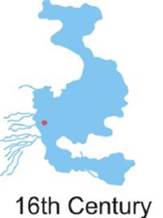

Source: Sliwa, M. (2014). Mexico City: Reconnecting an inland metropolis to water. In ISOCARP Congress, Gdynia, Poland.
Key factors included:
- Resonance: The earthquake’s shaking period of 1.5–2 seconds[3] coincided with the natural frequency of both the soft soil layer of the lake-bed basin (which was up to 50 meters thick) and the vibration frequency of mid-rise buildings (10–15 stories). This aligned with the frequency of seismic waves, triggering secondary resonance that intensified the shaking.
- Prolonged duration:
o The “Jelly Effect”: After seismic waves enter the soft clay layer, their energy is trapped and repeatedly reflected and superimposed within the basin. Picture a hard round-shaped bowl filled with jelly. If the bowl is shaken, the jelly continues shaking for considerably longer after the bowl stops shaking.
o Research[4] shows that this effect can significantly prolong the duration of intense shaking, by 170% to 290%, at the point of largest amplification.
- Wave focusing: The basin’s lens-like structure caused seismic waves to concentrate at the center, as they bounced back from the basin bottom. This resulted in significantly greater damage in the city center compared to the outlying areas.
The Myanmar Earthquake and Bangkok’s Vulnerability
On 28 March, 2025, a 7.9 magnitude earthquake struck Myanmar, with its epicenter southwest of Mandalay. However, 1,200 kilometers away, Bangkok, Thailand, experienced powerful ground shaking and unanticipated damage to a few high-rise buildings, revealing vulnerabilities in the city's disaster preparedness and urban building design.
Bangkok shares a few key geological and seismic characteristics with Mexico City:
- Distance from major fault lines: Bangkok is not situated on a major fault line (Figure 2) - the nearest is about 200 kilometers to its west - and has not seen a severe event in the past thousand years. The Sagaing fault in Myanmar, which triggered this event, is 400+ kilometers away at its closest point[5]. Mexico City is about 300km inland from the south coastal plate boundary which sees frequent earthquakes, although a few smaller faults lie closer to the city.
Figure 2: Seismic source zones that might impact Bangkok (red star marks the epicenter of this year’s Myanmar earthquake)
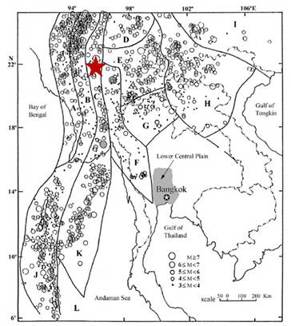
Source: Warnitchai, P., Sangarayakul, C., & Ashford, S. A. (2000, January). Seismic hazard in Bangkok due to long-distance earthquakes. In Proceedings of the 12th World Conference on Earthquake Engineering, Auckland, New Zealand (Vol. 30).
- Soft soil deposits: Bangkok rests on the alluvial basin of the Chao Phraya River delta, i.e. within a broad flat plain with unconsolidated delta sediments extending between 500 to 2000 meters deep5, much thicker and deeper than Mexico city, which sits on top of lake deposits of about 50 meters.
A river delta is also moister, with moisture in the top clay reaching 25%+, adding to the risk of liquification.
The Myanmar earthquake and the one near Mexico shared similarities in terms of prolonged shaking, but differences in terms of their resonance frequency:
- Prolonged shaking: The Myanmar earthquake shake lasted for about 90 seconds. However, in Bangkok, the shaking persisted for even longer, due to the “jelly effect”, similar to what was observed in the Mexico City earthquake. Seismic waves in the basin reflected at the edges causing energy to accumulate and exacerbating the swaying of high-rise buildings.
- Resonance: With deeper and softer sediment in Bangkok, the earthquake period of 0.8–1.2 seconds resonated with the natural vibration period of high-rise buildings (30+ floors), leading to amplified shaking and structural stresses causing unexpected damage[6]. Fortunately, the number of such high-rise buildings in Bangkok is limited, although potential losses tend to be higher for such buildings.
In contrast, the vibration period of Mexico City earthquake matched with 10-15 floors buildings, which were more common in Mexico in the mid-20th century.
Broader Implications for Urban Seismic Risk
The experiences of Mexico City and Bangkok reveal the risks that exist despite geographic distance from fault lines. In fact, several major cities located on soft sediment basins—such as Ho Chi Minh City, Kolkata, and those in the Yangtze River Delta—are exposed to similar risks from basin amplification. The threat could be even higher for cities closer to active faults, such as Beijing and Los Angeles.
Lessons from the 1985 Mexico City Earthquake
Following the 1985 disaster, Mexico adopted and enforced stricter seismic building codes and urban planning reforms. Exactly 32 years later, when another 7.1 magnitude earthquake struck the city on 19 September 2017, the damage to buildings was considerably lower, proving that the preventive measures were effective[7]. Despite larger accelerations in many areas of the city, buildings constructed according to the updated code generally performed well, with 90% of the collapsed buildings’ construction predating 1985[8].
For urban planners and government bodies, this underscores the importance of earthquake risk assessment and the need for a sophisticated understanding of the local geology and construction quality in managing risk and protecting lives and capital. Adjusting building codes for these risks and their strict enforcement can dramatically improve outcomes in major seismic events.
For (re)insurers and the catastrophe modelling industry, this case study highlights the need for earthquake modelling for regions further away from fault lines, and incorporating local geological conditions, such as sedimentary basin and soil characteristics, seismic science, construction practices and urban density in catastrophe modelling. This has implications for improving estimates on potential losses, enhancing tail risk management and financial resilience against large, unexpected earthquake events.
The legacy of the 1985 Mexico City earthquake is a reminder that proactive, science-driven approaches can save lives, reduce destruction, and build urban resilience against future natural catastrophes.
[1] Esteva, L. (1988). The Mexico earthquake of September 19, 1985—Consequences, lessons, and impact on research and practice. Earthquake Spectra, 4(3), 413-426.
[2] Beck, J. L., & Hall, J. F. (1986). Factors contributing to the catastrophe in Mexico City during the earthquake of September 19, 1985. Geophysical Research Letters, 13(6), 593-596.
[3] Mayoral, J. M., Asimaki, D., Tepalcapa, S., Wood, C., Roman-de la Sancha, A., Hutchinson, T., ... & Montalva, G. (2019). Site effects in Mexico City basin: Past and present. Soil Dynamics and Earthquake Engineering, 121, 369-382.
[4] Cruz-Atienza, V. M., Tago, J., Sanabria-Gómez, J. D., Chaljub, E., Etienne, V., Virieux, J., & Quintanar, L. (2016). Long duration of ground motion in the paradigmatic valley of Mexico. Scientific reports, 6(1), 38807.
[5] Warnitchai, P., Sangarayakul, C., & Ashford, S. A. (2000, January). Seismic hazard in Bangkok due to long-distance earthquakes. In Proceedings of the 12th World Conference on Earthquake Engineering, Auckland, New Zealand (Vol. 30).
[6] Tuladhar, R., Yamazaki, F., Warnitchai, P., & Saita, J. (2004). Seismic microzonation of the greater Bangkok area using microtremor observations. Earthquake engineering & structural dynamics, 33(2), 211-225.
[7] Phillips, E., Fraser, S., Murnane, R., Paul, N., Cox, K., & Daniell, J. (2018). Aftershocks: Remodeling the past for a resilient future. Retrieved from Washington, DC.
[8] Franke, K. W., Candia, G., Mayoral, J. M., Wood, C. M., Montgomery, J., Hutchinson, T., & Morales-Velez, A. C. (2019). Observed building damage patterns and foundation performance in Mexico City following the 2017 M7. 1 Puebla-Mexico City earthquake. Soil Dynamics and Earthquake Engineering, 125, 105708.
Disclaimer
Peak Re provides the information contained in this document for general information purposes only. No representation or guarantee is made as to the accuracy, completeness, reasonableness or suitability of this information or any other linked information presented, referenced or implied. All critical information should be independently verified and Peak Re accepts no responsibility or liability for any loss arising or which may arise from reliance on the information provided. All information and/or data contained in this document is provided as of the date of this document and is subject to change without notice. Neither Peak Re nor any of its affiliates accepts any responsibility or liability for any loss caused or occasioned to any person acting or refraining from acting on the basis of any statement, fact, text, graphic, figure or expression of belief contained in this document or communication.
All rights reserved. The information contained in this document is for your information only and no part of this document may be reproduced, stored or transmitted in any form or by any means, electronic, mechanical, photocopying, recording or otherwise, without the prior written permission of Peak Re. Any other information relating to this document, whether verbal, written or in any other form, given by Peak Re either before or after your receipt of this document shall be provided on the same basis as set out in this disclaimer. This document is not intended to constitute advice or recommendation, and should not be relied upon or treated as a substitute for advice or recommendation appropriate to any particular circumstances.
© 2025 Peak Reinsurance Company Limited.
Other Insights

Fri, 26 Jun 2026
| 17 mins
|
Edward Shen +1 more

Wed, 22 Apr 2026
| 16 mins
|
Frankie Chan
Tue, 24 Mar 2026
| 19 mins
|
Kritika Kashyap

Fri, 30 Jan 2026
| 18 mins
|
Kritika Kashyap

Elevate Your Business
with Peak Re
with Peak Re