




Global Economic Outlook 2026: New Engines of Growth in a Fragmenting World


Senior Vice President, Economist
- Global GDP growth is expected to remain resilient with the AI investment boom and fiscal spending providing offsets to drags from tariffs and trade wars. Regional growth divergence is widening.
- Rising trade fragmentation and industrial policy‑driven growth, while cushioning near‑term growth, may risk increasing capital inefficiency and government debt over time, potentially raising pressure on inflation and long-term interest rates.
- Within Emerging Asia, growth drivers vary: China is witnessing strong emergence of “new economy” sectors, India’s consumption-led expansion remains resilient, while ASEAN economies are benefiting, albeit unevenly from technology trade upcycle, trade divergence and supply-chain restructuring.
Overview
Global GDP growth in 2026 is expected to remain steady at 3.3%[1]. While the full impact of the US tariffs imposed in 2025 are expected to land in 2026, dragging down trade and growth, offsetting these, are tailwinds from AI and industrial policy pushing investments higher. Easing monetary and fiscal policy is also expected to provide additional support.
Uncertainty around the baseline remains high. The forecasts assume no further escalation in tariffs, but uncertainty remains historically high[2], and renewed conflicts or supply shocks are downside risks, while faster than expected AI-adoption and AI-driven productivity gains represent a potential upside risk.
Diverging regional growth: US economic growth is projected to rise to 2.4% (from 2.1% in 2025), while GDP growth in China and Euro area is expected to slow to 4.5% (from 5.0% in 2025) and 1.3% (from 1.4% 2025 estimate) respectively[1]. Emerging Asia continues to contribute over half of the global growth in 2026, with India and ASEAN-5 expected to remain resilient
Inflation is expected to continue normalising from post-pandemic highs, but core inflation in advanced markets still remains sticky. Upside risks to inflation may include US tariffs passthrough to consumer prices, and commodity volatility from geopolitical risks. On the other hand, inflation in Asia and Europe is expected to face downside price pressures in 2026 amid slowing external demand for goods.
Three macro forces shaping the economy in 2026
1. AI investments’ tailwind for growth
Global investment in AI-related infrastructure is estimated at over USD 300 billion in 2025 and climb to USD 500 billion in 2026[3], making AI a sizable macro driver for growth, particularly for the US, which saw the largest share of these investments. AI spending added an estimated 0.2-0.3% to advanced economies’ growth and about 1% to US economic growth in 2025[4]. China follows the US, with estimated AI spending between USD 84 to 98 billion in 2025[5], while AI investments in Europe and rest of Asia lagged[6]. Asia, however, is expected to benefit indirectly via the surge in AI related tech production and exports.
AI adoption and automation are expected to deliver a significant productivity boost to the global economy, long term, comparable to the advent of internet and personal computers. Estimates suggest AI adoption could add USD 16 trillion to the global economy by 2030[7] or about 3% annualised to global GDP growth. However, uneven adoption and investment across regions means that AI could also amplify growth and income divergence across economies.
2. Industrial policies and rising debt burdens
Industrial policies appear to be gaining importance in many advanced economies, as governments seek to respond to rising strategic competition, protectionism, and concerns around climate, national security and energy independence[8].
Governments across China, the UK, EU and the US, are deploying financial incentives like subsidies and tax incentives to steer capital into sectors such as advanced technology, AI, green technologies, critical minerals and defence[9]. In the near term, these measures are expected to support investment, domestic demand and labour markets, which may partially offset external headwinds and private‑sector caution.
However, the government spending towards these policies may contribute to persistent fiscal deficits and raise already high public debt burdens (see Figure 1), potentially adding upward pressure on long‑term interest rates and increasing the risk of crowding out private investment, reducing capital efficiency and increasing the economy’s vulnerability to future shocks.
Figure 1: Government debt to GDP ratio for select economies
|
General government debt-to-GDP (2024 end) |
|
|
Japan |
237% |
|
US |
121% |
|
UK |
101% |
|
China |
88% |
|
Euro area |
87% |
|
World |
93% |
Source: IMF Global Debt Database
3. Trade policy and deglobalisation
While the peak of the wave of tariff announcements may be behind us, in 2026, the delayed effects of tariffs are likely to pass through to economies.
The World Trade Organization projects global goods trade growth to slow to 0.5% in 2026[10], from 2.4% in 2025, signaling stalling trade volumes. This slowdown occurs despite strength in AI‑related goods and rising intra‑emerging‑market trade. This slowing in global external trade could especially be a drag for export-oriented economies, including China and EU.
At the same time, ongoing trade uncertainty is likely to contribute to reshaping supply chains, potentially driving up capital investments in manufacturing and strategic sectors in the near term. However, these dynamics could also lower capital efficiency due to supply chain redundancies and could contribute to a widening of growth divergence across regions.
Regional Outlooks
US: Steady, but narrowing growth drivers
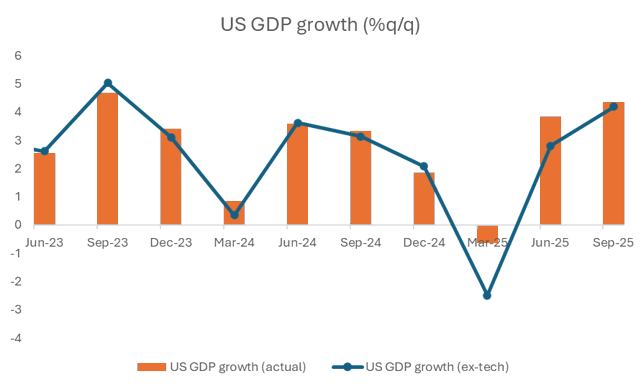
The US economy is expected to grow above potential, at around 2.4% in 20261, but its growth drivers appear to be narrowing. Tech and AI related capital expenditure were a major growth driver in 2025 (see Figure 2), offsetting the drag from higher trade tariffs, and sluggishness in other sectors of the economy. Fiscal spending is expected to be another tailwind with outlays in defence and industrial policies.
Consumption, the core of the US economy also appears to be narrowing. Household consumption is relying more heavily on the top‑20 percentile income households, whose earnings and wealth are more closely linked to financial market performance[11], while broader consumption is likely to be constrained by a cooling labour market and real wage pressures.
The increasing dependence on AI, financial markets linked consumption and fiscal spending suggest that growth may get more sensitive to AI execution and financing risks. A shortfall in AI‑related returns or a reduced market tolerance to rising fiscal deficit or inflation concerns —could transmit quickly to investment and consumption, potentially increasing economic fragility.
Figure 2: Tech and AI investment was a major contributor to US growth in 2025
Source: CEIC
Euro area: Moderating growth with fiscal policy in the driver’s seat
Euro area growth is expected to moderate. At the same time, government deficits projected to widen to a post‑pandemic high of 3.6% of GDP by 2027[12].
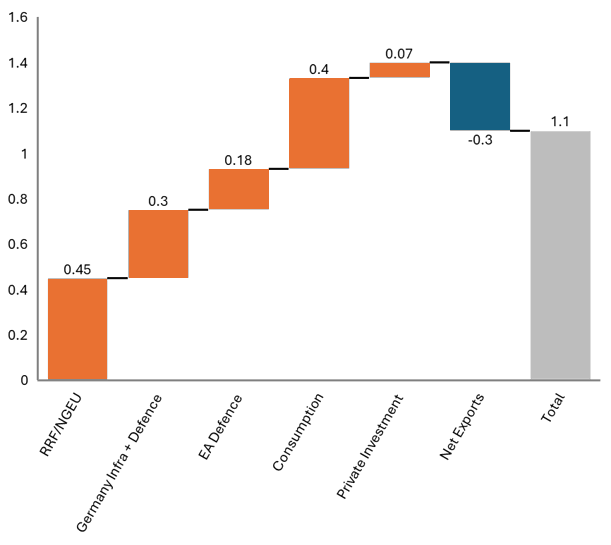
For 2026, the final year of NextGeneration EU/Recovery and Resilience Facility (RRF) execution is expected to contribute roughly 0.45pp to euro‑area GDP (see Figure 3). Germany is expected to add another 0.3pp through its sizeable 1% of GDP infrastructure and defence expansion. NATO’s new commitment[13] to raise defence spending to 5% of GDP by 2035—from 2% in 2024— is also expected to provide a modest macro boost, though the impact could be dampened by long procurement cycles and high import intensity.
Fiscal spending is expected to offset external drags from weak global demand, while household spending is supported by resilient labour markets and real income gains amid easing inflation. Public investments in infrastructure, digitalisation, and green energy are expected to help lift near term demand. However, without deeper structural reforms, fiscal support alone is unlikely to reinvigorate the private sector and close the region’s productivity gap, which continues to lag the US and Asia[14].
Figure 3: Estimated contribution to Euro area growth from fiscal drivers in 2026 (percentage points)
Source: CEIC, HSBC Research, Peak Re estimates
China: Supply-side growth remains strong, while demand lags
China’s GDP growth is expected to dip to sub 5% levels in 2026[1], amid property and consumer sector drags, as well as headwinds from external growth.
The “new economy” sectors (including AI and digital economy, advanced manufacturing and green technologies) continue to rise in importance. Official statistics show these sectors accounted for 18% of China’s GDP[15], and have emerged as the primary contributors to recent growth, surpassing the property sector’s contribution. The 2026–2030 Five‑Year Plan further reinforces this shift, prioritising high‑quality growth, technological self‑reliance and green transition as core pillars of China’s development strategy.
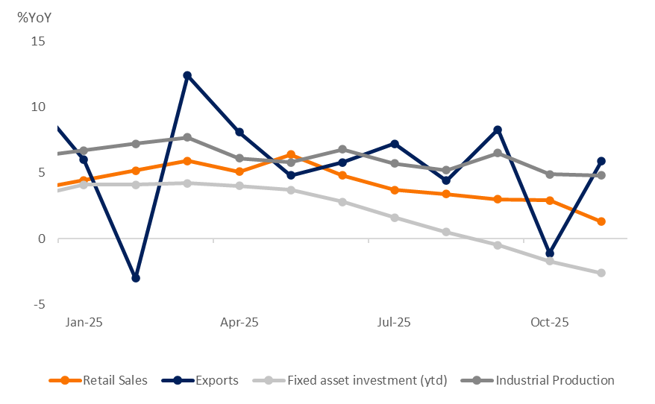
External trade provided critical support in 2025, with trade surplus hitting a record US$1.08 trillion over 11 months. However, slowing global demand, delayed tariff effects, and potential payback from front-loaded orders point to softer export momentum in 2026.
Domestically, fixed asset investment contracted 2.6% year-on-year (see Figure 4), including a reported 16% fall in real estate investment in 2025. Retail sales momentum also slowed in lockstep as dampened property and wage income expectations, and fading impact of earlier trade-in subsidies weigh on consumer confidence. Fiscal spending is expected to offset some of the domestic slowdown, with 4% of GDP or RMB 1 trillion in incremental government spending expected to focus on welfare, equipment upgrades, and key projects.
CPI inflation is subdued near 1%, while producer prices are likely to stay in deflation. Moderate monetary policy accommodation has been indicated for 2026[16], but the weakening inflation outlook will likely require progress on structural rebalancing and supply-side cuts to generate a sustainable shift.
Figure 4: China: Key economic activity indicators performance in 2025
Source: CEIC
India: Fastest‑growing major economy
India is projected to grow at 6.4–6.7% in FY 2026-27[1][17], after a strong FY 2025-26 growth of 7.3%. Resilient domestic consumption and sustained public‑sector infrastructure spending are expected to continue to anchor growth despite India facing among the highest US trade tariffs[18].
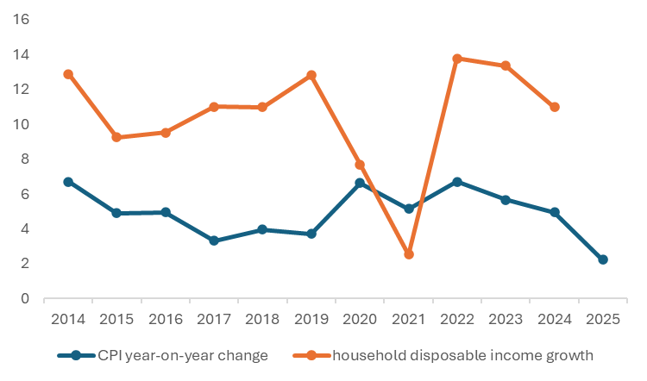
Consumption growth has remained robust, with real household disposable incomes growing at a sustained pace of around 5% CAGR over the last few years (see Figure 5), and more recently aided by tax cuts, GST rationalisation and a decline in inflation, which have helped improve household purchasing power.
Rural consumption growth is outpacing urban demand growth[19], supported by better rural credit growth and rising non‑farm jobs such as services, construction and logistics, pointing to a potential structural shift in rural wage patterns.
Public capex was maintained at 3.4% of GDP in FY2025-26, which continues to support in crowding in private investment, reinforcing productivity gains and improving employment and income outcomes across construction, logistics, and services.
On the external sector, India’s goods exports have been volatile[20], weighed down by record high US tariffs and uncertain global demand, while services exports - IT and professional services - are expanding at a steady pace. However, higher gold imports and weaker foreign capital inflows have contributed to wider external imbalances, making currency depreciation a key risk to monitor.
Despite these challenges, India’s macro fundamentals appear sound, with a manageable fiscal deficit, contained inflation, and a deep domestic market that helps absorb adverse external sector impacts.
Figure 5: India: Disposable income growth versus inflation
Source: CEIC, Ministry of Statistics and Programme Implementation
ASEAN: Steady growth amid trade headwinds and rising intra‑regional differentiation
ASEAN‑5 growth is projected to remain steady at around 4.2% in 2026, broadly unchanged from 2025, as resilient domestic demand and policy support are expected to offset weaker global trade conditions.
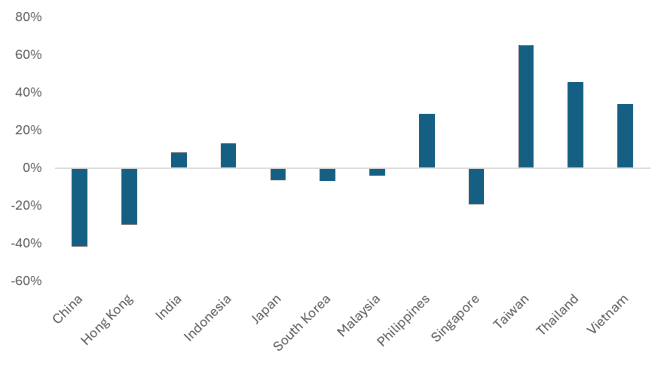
Trade patterns are becoming increasingly differentiated across the region. For example, following the implementation of US tariffs in August 2025, despite a contraction in overall US imports and a notable decline in exports from China and Hong Kong to the US, several Asian economies—particularly Taiwan, Vietnam, Thailand, the Philippines - recorded strong exports growth to the US (see Figure 6), reflecting gains from the global tech upcycle, trade rerouting, and ongoing supply‑chain reconfiguration.
At the same time, a surge in imports from China has helped contain inflation across the region, which is supportive of consumers’ purchasing power, but has also intensified competitive pressures on domestic manufacturers.
Fiscal policy remains a key driver of divergence within ASEAN. Vietnam’s expansionary infrastructure push and continued FDI inflows are assessed to be crowding in private investment, while Malaysia’s subsidy rationalisation is viewed to have improved fiscal efficiency without undermining household confidence. In contrast, sentiment in Thailand and the Philippines has been more subdued amid fiscal implementation slippage and political uncertainties. Indonesia remains relatively more resilient, supported by robust consumption, prudent macro management, and stable inflation.
Figure 6: Asia’s merchandise exports to the US for August to October 2025 (year-on-year change)
Source: CEIC, Peak Re
Summary
The global economy in 2026 appears stable on the surface, but beneath it, growth drivers are continuing to shift, with AI, industrial policy, and trade fragmentation expected to drive divergent outcomes across regions. Geopolitical and geoeconomic uncertainty remains at record highs, posing a key risk to the outlook. AI is increasingly viewed as a meaningful macro force, with the potential to lift productivity and growth over time, while also introducing new concentration, execution, and financial risks.
At the same time, rising nationalism and protectionism are accelerating supply‑chain realignments and intensifying strategic and security‑driven competition. A more deglobalised world is likely to entail greater inefficiencies and heightened competitive pressures, which may contribute to higher inflation, higher public debt and elevated long‑term interest rates relative to the pre‑pandemic era.
Against this backdrop, 2026 appears to be less about the absolute pace of global growth and more about where growth is concentrated, how durable it proves to be, and how sensitive it has become to execution challenges and financial conditions.
[1] All GDP growth and inflation projections throughout the report are referenced from the IMF World Economic Outlook Update, January 2026
[2] Economic Policy Uncertainty, Trade Policy Uncertainty Index
[3] Goldman Sachs: Why AI Companies May Invest More than $500 Billion in 2026, December 2025
[4] JP Morgan Asset Management: Is AI already driving US growth?, 19 December, 2025
[5] SCMP: China’s AI capital spending set to reach up to US$ 98 billion in 2025 amid rivalry with US, 25 June, 2025
[6] Stanford University Human-Centered Artificial Intelligence: The 2025 AI Index Report, April 2025
[7] World Economic Forum: The global economy will be $16 trillion bigger by 2030 thanks to AI, June 2017
[8] Council on Foreign Relations: Repositioning the Debate on Subsidies and Industrial Policy, 3 November 2025
[9] McKinsey & Company: From protection to promotion: The new age of industrial policy, 16 May, 2025
[10] World Trade Organization: AI goods and frontloading lift world trade in 2025 but outlook dims for 2026, October 2025
[11] Royal Bank of Canada: US Analysis: How household wealth is helping drive consumption in the US, 18 November 2025
[12] IMF Fiscal Monitor, October 2025
[13] NATO: Defence expenditures and NATO’s 5% commitment, 18 December 2025
[14] OECD Economic Surveys: European Union and Euro Area 2025, July 2025
[15] National Bureau of Statistics of China: The Proportion of Value Added by "Three New" Economy in GDP for 2024 is 18.01%, 1 August 2025
[16] Xinhua: China's central bank signals further RRR, interest rate cuts to bolster growth, 22 January 2026
[17] India’s financial year runs from April to March: FY 2026-27 represents April 2026 to March 2027.
[18] Federal Register: Addressing Threats to the United States by the Government of the Russian Federation, 6 August, 2025
[19] Press Information Bureau, Government of India: Household Consumption Trends, January 2025
[20] Government of India: Ministry of Commerce and Industry: Trade Statistics
Disclaimer
Peak Re provides the information contained in this document for general information purposes only. No representation or guarantee is made as to the accuracy, completeness, reasonableness or suitability of this information or any other linked information presented, referenced or implied. All critical information should be independently verified and Peak Re accepts no responsibility or liability for any loss arising or which may arise from reliance on the information provided. All information and/or data contained in this document is provided as of the date of this document and is subject to change without notice. Neither Peak Re nor any of its affiliates accepts any responsibility or liability for any loss caused or occasioned to any person acting or refraining from acting on the basis of any statement, fact, text, graphic, figure or expression of belief contained in this document or communication.
The information is not intended to constitute, and should not be construed as, investment research, investment advice, financial advice, or a recommendation of any kind.
All rights reserved. The information contained in this document is for your information only and no part of this document may be reproduced, stored or transmitted in any form or by any means, electronic, mechanical, photocopying, recording or otherwise, without the prior written permission of Peak Re. Any other information relating to this document, whether verbal, written or in any other form, given by Peak Re either before or after your receipt of this document shall be provided on the same basis as set out in this disclaimer. This document is not intended to constitute advice or recommendation, and should not be relied upon or treated as a substitute for advice or recommendation appropriate to any particular circumstances. © 2026 Peak Reinsurance Company Limited.
Other Insights

Fri, 26 Jun 2026
| 17 mins
|
Edward Shen +1 more


Wed, 22 Apr 2026
| 16 mins
|
Frankie Chan

Tue, 24 Mar 2026
| 19 mins
|
Kritika Kashyap
Mon, 27 Oct 2025
| 10 mins
|
Kritika Kashyap

Elevate Your Business
with Peak Re
with Peak Re