



Risk and Resilience: Mindset of Emerging Asia’s Middle Class on Climate, Economy and Protection Gaps

Senior Vice President, Economist
A synopsis of insights from Peak Re’s 2025 Emerging Asia Middle Class Consumer Survey
In the fourth edition of the Peak Re’s Emerging Asia Middle Class Consumer Survey[1] (“Peak Re Survey”), we continue to build our understanding of the dynamic and economically vital middle-class demographic. This year’s report, titled “Risk And Resilience”, explores the Emerging Asian middle class mindset on Climate, Economy and Protection. We also examine small and medium enterprises’ (SMEs) perceptions on cyber-risks, and investigate how pre-existing medical conditions affect consumer attitudes towards health and critical illness insurance.
How Economic Sentiment Influences Spending Behaviour of the Emerging Asian Middle Class
Peak Re’s Survey shows that Emerging Asia’s middle-class consumers are optimistic about their local economies, with those in Vietnam and India the most optimistic (>80%), and with the exception of Thailand where less than half reported a buoyant economic sentiment.
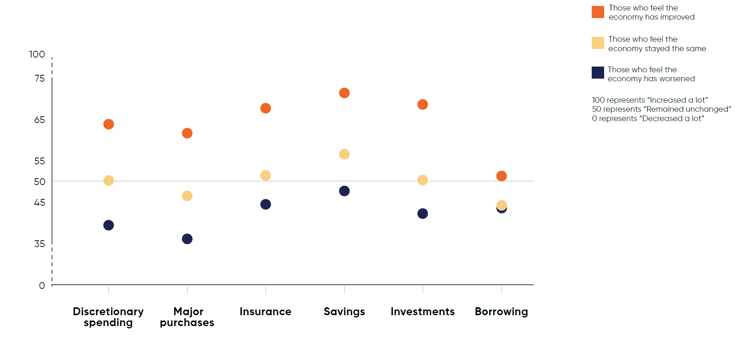
Sentiment affects financial allocations. The optimistic respondents reported increasing their spending, but are even more interested in increasing their savings, investments and insurance spending (see Figure 1). In contrast, those who are pessimistic about the economy look to cut discretionary spending and major purchases the most.
Notably, insurance spending is sticky: optimists plan to boost it, while pessimists are reluctant to reduce it. A common trait we find across the board in Emerging Asia is a focus on deleveraging, with pessimists more motivated to reduce borrowing than their optimistic counterparts.
Figure 1: Household Financial Allocation by Economic Sentiment
Source: Peak Re Consumer Survey 2025
Perception around Protection Gaps: Middle-class Optimism Masks Growing Risk Exposure
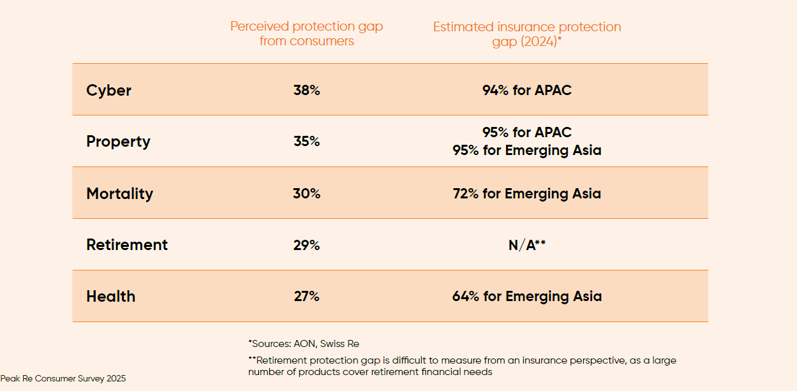
According to Peak Re’s Survey, the Emerging Asia middle class significantly underestimates their protection gaps across property, health, retirement, mortality, and cyber.
On average, respondents perceived their protection gaps as small to moderate across different risks – ranging from 27% for health to 35% for property and 38% for cyber - falling significantly behind industry estimates (see Figure 2).
Some trends stand out:
- On average, the lower middle class feels more exposed to these risks than the higher middle class.
- Consumers feel more exposed to cyber risk and natural catastrophe risk, while they seem to have a better understanding of their protection needs related to health and mortality.
- The middle-class consumers’ significant underestimation of cyber and property risks, in particular, present an opportunity for insurers to deepen engagement with for consumers around these risks.
Figure 2: Comparison between Perceived and Industry Estimated Protection Gaps
Source: Peak Re Consumer Survey 2025
Encouragingly, consumers cite insurance as the top source for covering their protection gaps. However, around 10% of consumers did not have any plans to seek coverage across risks. Cyber protection stands out in that a higher percentage of consumers (16%) expect to remain uncovered for losses, and rely less on insurance for support.
Mindset on Climate Change: Aware, Affected and Embracing Responsibility for Climate Action
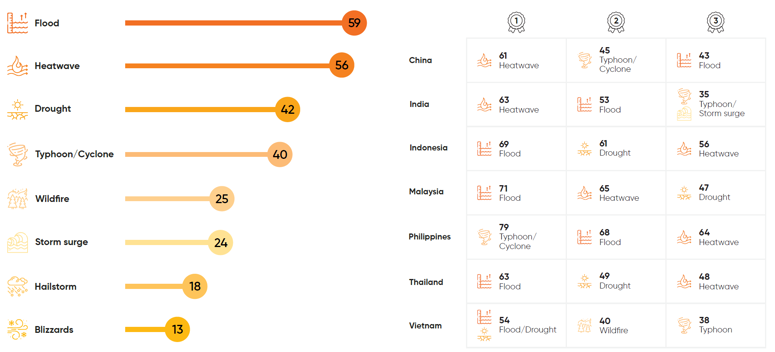
Consumers in Emerging Asia’s middle class feel vulnerable to climate change, with 43% expecting climate change to significantly impact their lives in the next three years. Floods and heatwaves top their concerns around extreme weather (see Figure 3).
When asked about how extreme weather has impacted their lives in the past, 41% reported health impacts, 37% mentioned disruption to daily commute, and 32% reported property damage. Consumers in Vietnam and India cited the most weather-related disruptions in the past.
Importantly, the Emerging Asian middle class see themselves as key agents for climate action - second only to governments. They are actively adopting behaviours like reducing electricity consumption and choosing sustainable products. This mindset also reflects in their keen interest in green insurance, with 80% expressing interest in insurance products that promote climate adaptation, mitigation, and support for energy transition.
Figure 3: Extreme weather events that most impacted daily life (%)
Source: Peak Re Consumer Survey 2025
SME Commercial Cyber: Widening Gap between Risks and Perceptions
A significant 85% of SMEs we surveyed said they had encountered cyber threats in the past, with 28% reporting disruptions to their operations as a result. They cited data breaches (41%), phishing and email fraud (36%) and AI driven attacks and fraudulent websites (32%) as the most commonly experienced cyber threats with SMEs in India and Vietnam reporting the most cyber incidents across different threat types. India notably stated significant business interruption (41%) linked to cyber incidents.
42% of SME owners believe a cyberattack could have significant financial impact on their business, and could jeapordise the financial health of the company.
Nonetheless, 73% felt their current IT systems are sufficient to protect them against cyber risks, and 44% did not seek cyber protection. When asked for reasons for not purchasing cyber insurance (while being aware of it), the top reason is “the risks facing my company are low/bearable”. This mismatch between growing cyber risks versus a sense of security among SMEs highlights a widening protection gap and a need for raising risk awareness in this area.
Health and Critical Illness Covers with Pre-existing Medical conditions: Seeking Flexible Coverage
Hypertension and diabetes are the most prevalent health conditions among the Emerging Asia middle class, according to Peak Re’s Survey, with India and Philippines also reporting high rates of depression and obesity.
Those with medical conditions worry most about the costs of long-term care, losing financial stability and becoming a burden on caregivers. This fear is higher where reliance on public healthcare is lower, notably in Philippines and Indonesia.
Despite their concerns, 46% believe they have sufficient coverage from policies purchased before the conditions developed, and another 12% did not seek additional coverage worrying that the quoted premiums or coverage triggers may be too high.
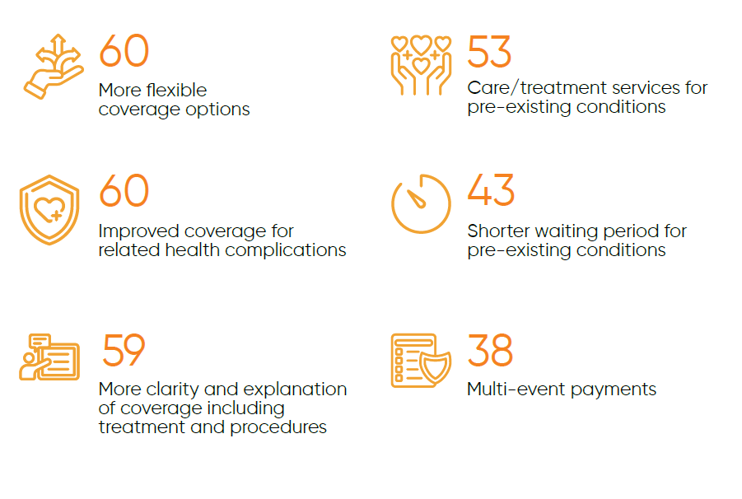
31% said they were successful in obtaining additional health coverage with higher premiums, additional terms and conditions and/or exclusions, and saw significant scope for improvement with the offer received. Greater flexibility, improved coverage for related health conditions and more clarity on coverage of treatments and procedures are the key needs from the insurance offer (see Figure 4).
Figure 4: Individuals with pre-existing health conditions seek improvements in the health/critical illness insurance offer (%)
 Source: Peak Re Consumer Survey 2025
Summary: Addressing Protection Gaps
In a global environment of rising uncertainty, the Emerging Asian middle-class remains a powerful economic force, where a strong sense of optimism fuels not only spending, but also savings, investments and insurance spending.
However, underlying this upbeat outlook is a significant underestimation by the middle-class of their protection gaps, particularly for natural catastrophe and emerging risks like cyber.
Natural catastrophes and climate change present a clear and present risk – and the middle class recognises it as so – with many already seeing health effects, disruptions to work and daily life and property damage from extreme weather events. On the other hand, SME owners, while facing real cyber threats, still highly underestimate their risk exposures.
The findings from Peak Re’s Survey underscore the need to investigate the nuanced attitudes, needs and behaviors of this key segment. Only by recognising the protection gaps, enhancing risk awareness, and tailoring innovative solutions can re/insurers truly support this dynamic and diverse segment, helping secure their financial futures in an evolving world.
[1] The survey was conducted by Intuit Research between 27 May to 5 June, 2025, and included over 8000 respondents across Emerging Asia. As defined by the International Monetary Fund (IMF), this group includes seven economies, namely, China, India, Indonesia, Malaysia, Philippines, Thailand and Vietnam. The middle-class was defined for this study as any household with an income between 2/3 and 3x the local median household income.
Disclaimer
Peak Re provides the information contained in this document for general information purposes only. No representation or guarantee is made as to the accuracy, completeness, reasonableness or suitability of this information or any other linked information presented, referenced or implied. All critical information should be independently verified and Peak Re accepts no responsibility or liability for any loss arising or which may arise from reliance on the information provided. All information and/or data contained in this document is provided as of the date of this document and is subject to change without notice. Neither Peak Re nor any of its affiliates accepts any responsibility or liability for any loss caused or occasioned to any person acting or refraining from acting on the basis of any statement, fact, text, graphic, figure or expression of belief contained in this document or communication.
All rights reserved. The information contained in this document is for your information only and no part of this document may be reproduced, stored or transmitted in any form or by any means, electronic, mechanical, photocopying, recording or otherwise, without the prior written permission of Peak Re. Any other information relating to this document, whether verbal, written or in any other form, given by Peak Re either before or after your receipt of this document shall be provided on the same basis as set out in this disclaimer. This document is not intended to constitute advice or recommendation, and should not be relied upon or treated as a substitute for advice or recommendation appropriate to any particular circumstances.
© 2025 Peak Reinsurance Company Limited.
Other Insights

Fri, 26 Jun 2026
| 17 mins
|
Edward Shen +1 more

Wed, 22 Apr 2026
| 16 mins
|
Frankie Chan
Tue, 24 Mar 2026
| 19 mins
|
Kritika Kashyap

Fri, 30 Jan 2026
| 18 mins
|
Kritika Kashyap
Elevate Your Business
with Peak Re
with Peak Re