



Strengthening Heat Resilience at Work in a Warming World


Senior Vice President, Sustainability Officer
- Climate-driven heat stress jeopardises over 70% of workers globally, eroding health and productivity while imposing rising costs.
- Cultural norms and economic pressures could hinder effective prevention and adaptation to heat stress at work, with informal and gig workers particularly vulnerable.
- It requires stakeholders’ collaboration to develop and implement holistic and effective occupational heat resilience strategies, including WBGT-based regulations, technology-enabled monitoring systems, and innovative insurance products, to build “heat-proof” workplaces.
Globally, 2.4 billion workers, or 70% of the global working population, are exposed to excessive heat, according to estimates from the International Labour Organization (“ILO”). This exposure leads to 22.85 million non-fatal injuries and 18,970 deaths annually.
The ILO also estimates that the cost of heat related injuries can reach US$361 billion, or equivalent to 1.5% of a low to lower-middle-income country’s GDP[1]. As global warming increases human exposure to hot weather, heat is being recognised as an emerging sustainability issue, that threatens workplace safety, productivity and lives.
Heat crisis on the rise amidst climate change
While global mean temperatures are rising, Asia is warming at nearly double the global average rate, according to the World Meteorological Organization’s (“WMO”) report on the State of Climate in Asia 2024[2]. This warming trend continued to manifest in extreme heat in many parts of Asia in 2025. Several countries, such as Japan[3] , Republic of Korea[4] and China[5], recorded their hottest summers on record. The early arrival of intense heatwaves as early as April affected South and Southeast Asia with temperatures exceeded 40°C in parts of India, Thailand, Myanmar and several places across the region[6]. The situation is likely to worsen in the coming years as the WMO predicts an 80% chance that at least one year between 2025 to 2029 will surpass 2024 as the warmest year on record[7].
Furthermore, the Intergovernmental Panel on Climate Change (“IPCC”) Sixth Assessment Report (“AR6”)[8] projects that the global temperature will continue to rise at least until the middle of the century. Under the intermediate climate scenario (SSP2-4.5)[9], this trend is expected to result in a significant increase in the annual number of hot days towards end of the century. For example, under this scenario, Hong Kong is projected to experience 95 days per year with maximum temperature of 33°C or above[10] while Singapore may see 266 days annually with maximum temperature exceeding 34°C[11].
Heat impacts on workers’ health and performance
Heat stress describes a situation in which the human body has difficulty effectively cooling itself and maintaining a normal internal temperature. Exposure to high air temperature can contribute to heat stress when heat accumulates in the human body more quickly than the body’s ability to dissipate it, which may place additional strain on the body.
Key risk factors contributing to heat stress include environmental conditions (such as air temperature, humidity, air flow and radiant heat), level of physical activity generating metabolic heat, thermal insulation such as clothing that limits heat loss, and personal factors (e.g. age and health conditions)[12].
One common index for measuring heat stress is the Wet Bulb Globe Temperature (“WBGT”), which integrates air temperature, humidity, heat radiation and wind speed to assess heat stress on human body. The International Organization for Standardization (“ISO”) provides detail guidance for WBGT assessment[13].
Failure in the body’s ability to regulate temperature can initially cause mild symptoms like heat cramps and heat syncope but, if not addressed promptly, can rapidly progress to serious conditions such as heat exhaustion or even a fatal heatstroke.
Prolonged exposure to excessive heat can worsen chronic conditions such as cardiovascular, respiratory and diabetes-related conditions[14]. Timely identification of early symptoms and interventions are crucial to reducing the risk of heatstroke.
Heat stress also impacts workers’ performance. As summarised in the joint report issued by World Health Organization (“WHO”) and WMO, exposure to excessive heat at work can impair judgement, concentration, vigilance, dexterity, coordination and drive psychological distress, undermining information processing capacities. Under these mental states, workers may overlook safety procedures or may be distracted, which could lead to accidents, resulting in injuries and fatalities. The joint report highlights that every WBGT degree increase beyond 20°C leads to 2% to 3% drop in productivity[15].
The ILO estimates that 75% of the workforce in Asia and the Pacific are exposed to excessive heat[16]. Under hot and humid weather, workers involved in physical activities outdoors are more vulnerable, such as those in construction, agriculture, fisheries, street vending and food delivery industries where environmental heat exposure is inevitable. Workers in indoor environments without air conditioning and poor ventilation could also be at risk. Workers wearing personal protective equipment at work could experience a further increase in the risk of heatstroke.
Barriers to heat safety: cultural factors and economic pressures
There is no lack of advice and recommendations from heat health experts on prevention, mitigation and adaptive measures for people living in hot environments. For instance, the Global Heat Health Information Network, supported by WMO and WHO, provides an online repository of research, learning materials and recommendations related to heat health. Some of the tips may seem like common sense, such as staying cool, slowing down or stopping physical activities and drinking water to keep hydrated when it is too hot. However, many people continue to push themselves beyond their heat stress limits, ignoring early warning signs and delaying timely mitigation actions.
In some settings, cultural expectations around perseverance, a competitive workplace culture or working under tight timelines could be factors discouraging workers from resting despite experiencing early symptoms of heat illness. Furthermore, excessive heat can also affect workers’ cognitive focus, potentially making it more challenging for individuals to adhere to safety protocols and follow safety recommendations[17]. Balancing operational goals with proactive health and safety measures is essential to ensure workers do not overextend themselves during periods of extreme heat.
Informal and gig workers, like food delivery riders, face unique challenges in managing heat exposure. The nature of flexible work arrangements could require weighing taking preventative rest breaks against immediate income opportunities. These economic and environmental factors create a complex trade-off for workers in this segment when navigating health and safety considerations associated with extreme heat.
Making occupational heat safety measures effective
Mitigating heat risks at work requires a holistic approach including policy support, training and raising awareness as well as aligning interests among stakeholders for effective implementation of occupational heat safety measures.
Governments setting clear policies on heat-health and safety at work can send a strong signal to market participants, urging action. As examples, Hong Kong, Singapore, and Japan have implemented workplace heat stress rules and regulations based on the WBGT index to safeguard workers' health. Hong Kong uses a color-coded Heat Stress at Work Warning system and mandates heat risk assessments[18], while Singapore enforces legal obligations on employers to manage heat risks, with penalties for non-compliance and detailed guidelines under different WBGT bands[19]. Japan’s new law, effective June 2025, requires employers to monitor WBGT levels and adopt mitigation measures such as buddy systems and health monitoring, with fines for violations[20].
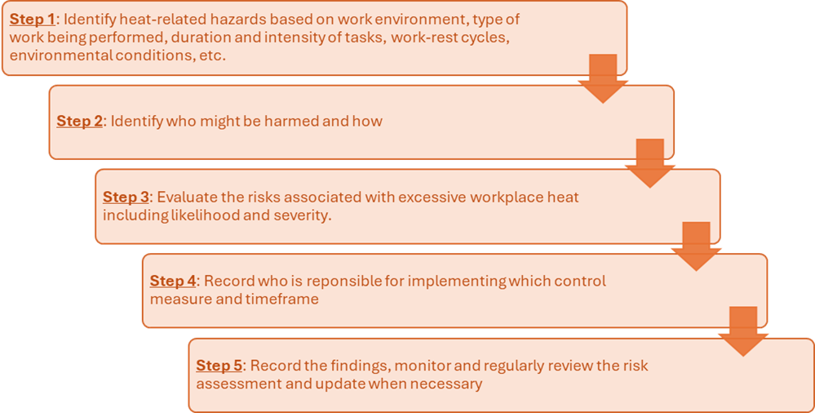
When applying heat safety strategies at workplace, employers should first conduct a comprehensive risk assessment to identify specific heat-related risks and hazards based on the working environment and the tasks involved and evaluate if established control measures are sufficient and appropriate. The ILO recommends a five-step guide for employers (Figure 1)[21].
Figure 1: A Five-step guide for conducting workplace risk assessment
Source: International Labour Organization
It is important to raise awareness among employers, supervisors and workers on heat stress and heat-related illness and the merits of implementing effective heat mitigation and prevention measures. For instance, employers may benefit from reducing absenteeism, sustaining productivity and improved operational resilience by implementing measures to “heat-proofing” their operations. Reducing heat-related injuries and accidents at work creates a win-win situation for both employers and employees.
Role of insurance in strengthening workplace heat resilience
The evolving impact of heat stress on the insurance sector is an important consideration. The health impacts associated with rising temperatures are expected to influence claims trends across several lines of business, including life, medical, and workers’ compensation. As global temperatures continue to rise, the industry will need to closely monitor these developments, as shifting claims patterns could influence the cost of protection and shape the dynamics of insurance affordability and availability in the long term.
An ounce of prevention is worth a pound of cure. Insurers can benefit from promoting workplace heat safety and heat health impact education to the broader public and policymakers. In addition to providing workers’ compensation insurance, which is often mandatory, insurers could support employers in assessing the heat stress risk at workplace, advise on and encourage them to take specific measures to prevent, mitigate and adapt to the increasingly hot working conditions.
Insurers can also analyse claims data across various lines of business to identify hotspots, regions or worker groups facing greater heat-related risks, enabling them to develop tailored products and targeted mitigation strategies for communities that are most in need of support.
Technology can help enhance monitoring and early detection of heat stress. In Japan, wearable tools such as wristbands, helmet and clothing devices are often used to track body temperature and heat rate in real time where alerts will be issued if it shows signs of heat stroke. An AI-enabled solution is also being developed to assess workers’ heat stroke risks by analysing facial expressions, perspiration and flushing[22]. Where appropriate, insurers may consider providing incentives to employers for effective heat safety measures taken.
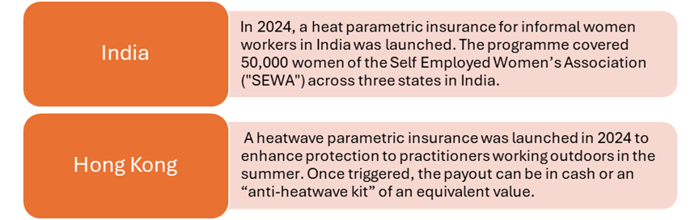
For informal workers and gig workers who are often not covered by traditional workers’ compensation, it would require collaboration and innovation in developing solutions to provide protection and address their practical needs. Parametric products that are simple and fast in paying claims when pre-determined thresholds are met can potentially play a key role in building heat resilience for these vulnerable workers. Getting claims payout on a dangerously hot day could make all the difference for them and their loved ones. Heat-related parametric insurance products have started to emerge, with examples seen in India [23] and Hong Kong [24]. (Figure 2)
Figure 2: Examples of heat-related parametric insurance for workers
Sources: Climate Resilience for All; AXA Hong Kong and Macau
Conclusion
Occupational heat stress deserves more attention as one of the most pressing sustainability challenges. It demands immediate and coordinated actions among governments, employers, workers, insurers and other stakeholders that move beyond reactive measures to embrace comprehensive heat resilience strategies. As global mean temperatures continue to rise, those who fail to adapt may face challenges in maintaining long-term productivity and economic competitiveness. The insurance industry should collaborate and innovate with other stakeholders to build workplaces that are resilient and adaptive to a warming world.
[1] ILO: Heat at work: Implications for safety and health, 25 July 2024
[2] WMO: State of Climate in Asia 2024, 23 June 2025
[3] Japan Meteorological Agency: Press Release, 30 September 2025
[4] The Korea Times: Nation records hottest summer on record in 2025, 1 September 2025
[5] China Daily: China sees hottest summer ever, 2 September 2025
[6] The Strait Times: Record heatwave of up to 45 deg C scorches much of Asia, 20 April 2025
[7] WMO: Global Annual to Decadal Climate Update 2025-2029, 26 May 2025
[8] IPCC: AR6 Summary for Policymakers, March 2023
[9] The SSP2-4.5 scenario is the “middle of the road” shared socioeconomic pathways. It assumes emissions will peak around mid-century and will not reach net-zero by 2100. The temperature rise will be 2.7°C by 2100, exceeding the Paris Agreement targets.
[10] Hong Kong Observatory: Projection of very hot days for Hong Kong,
[11] Meteorological Services Singapore: Report for Stakeholders, Singapore’s Third National Climate Change Study, 2024
[12] U.S. Occupational Safety and Health Administration: Heat Hazard Recognition
[13] ISO 7243:2017 - Ergonomics of the thermal environment — Assessment of heat stress using the WBGT (wet bulb globe temperature) index, 2017
[14] Global Heat Health Information Network: Heat and Health
[15] WHO and WMO: Climate change and workplace heat stress technical report and guidance, 22 August 2025
[16] ILO (See footnote 1)
[17] ILO (See footnote 1)
[18] Hong Kong Labour Department: Guidance Notes on Prevention of Heat Stroke at Work, 2 May 2024
[19] Singapore Ministry of Manpower: Heat Stress Measures for Outdoor Work
[20] The Japan Times: Protect workers from heat waves or face fines, Japan tells firms, 2 June 2025
[21] ILO (See footnote 1)
[22] World Economic Forum: How Japanese companies are adapting to rising heat risks in the workplace, 5 September 2025
[23] Climate Resilience for All: Press Release “World-first financial product combining insurance and cash payments for extreme heat is a lifeline for 50,000 informal women workers in India”, 12 June 2024
[24] AXA Hong Kong and Macau: Press Release “AXA Launches Pioneering Heatwave Parametric Insurance”, 5 August 2024
Disclaimer
Peak Re provides the information contained in this document for general information purposes only. No representation or guarantee is made as to the accuracy, completeness, reasonableness or suitability of this information or any other linked information presented, referenced or implied. All critical information should be independently verified and Peak Re accepts no responsibility or liability for any loss arising or which may arise from reliance on the information provided. All information and/or data contained in this document is provided as of the date of this document and is subject to change without notice. Neither Peak Re nor any of its affiliates accepts any responsibility or liability for any loss caused or occasioned to any person acting or refraining from acting on the basis of any statement, fact, text, graphic, figure or expression of belief contained in this document or communication.
All rights reserved. The information contained in this document is for your information only and no part of this document may be reproduced, stored or transmitted in any form or by any means, electronic, mechanical, photocopying, recording or otherwise, without the prior written permission of Peak Re. Any other information relating to this document, whether verbal, written or in any other form, given by Peak Re either before or after your receipt of this document shall be provided on the same basis as set out in this disclaimer. This document is not intended to constitute advice or recommendation, and should not be relied upon or treated as a substitute for advice or recommendation appropriate to any particular circumstances.
© 2026 Peak Reinsurance Company Limited.
Other Insights

Fri, 26 Jun 2026
| 17 mins
|
Edward Shen +1 more

Tue, 24 Mar 2026
| 19 mins
|
Kritika Kashyap

Fri, 30 Jan 2026
| 18 mins
|
Kritika Kashyap
Mon, 27 Oct 2025
| 10 mins
|
Kritika Kashyap

Elevate Your Business
with Peak Re
with Peak Re