



Spillovers from the Iran War for Global and Asian economies

Senior Vice President, Economist
- The Iran war has triggered an energy and shipping shock via the Strait of Hormuz, driving up oil, gas and freight costs, with macroeconomic implications for the global economy, especially if the conflict and trade disruptions are prolonged.
- Asian economies are the largest importers of Middle East oil and gas, but their economic vulnerability is differentiated by their import dependence, strategic oil reserves and government policies on domestic price pass-through.
- For re/insurance markets, the conflict has several layers to assess - direct war exposure (usually limited), supply chain disruptions, and the broader macroeconomic fallout – with implications for multi-line accumulation and claims inflation.
An energy and shipping shock, not limited to the Middle East
The ongoing conflict in Iran, which has been escalating since 28 February, has taken a tragic human toll. As the international community navigates the humanitarian crisis, global markets are also bracing for severe economic spillovers, particularly concerning energy and global supply chains. A key transmission channel is the Strait of Hormuz, a critical maritime energy chokepoint, through which about a quarter of seaborne oil trade [1] - about 20 million barrels per day - and about one-fifth of liquefied natural gas (LNG) flows [2].
Recent disruptions, including the suspension of commercial shipping and the repricing or withdrawal of war risk insurance for the area, have contributed to wider uncertainty in global energy and freight markets.
Recent disruptions, including the suspension of commercial shipping and the repricing or withdrawal of war risk insurance for the area, have contributed to wider uncertainty in global energy and freight markets.
Oil and gas prices have risen significantly since the conflict started. Brent crude oil prices have risen from USD 70/bbl before the war to over USD 100/bbl and natural gas prices are up 40-50% across key hubs. With transport disrupted, production in many large fields has halted. Reported and potential damage to several critical oil and gas fields and refineries in the region is another risk that can keep oil and gas prices elevated for months.
The energy price shock can transmit to the real economy via three main channels:
- Trade and production: higher input costs and potential supply interruptions, particularly for energy intensive industries.
- Inflation and real incomes: higher fuel and utility prices can erode households’ purchasing power and compress business profit margins.
- Financial markets and confidence: for exposed sovereigns and corporates, the oil price shock can feed-through to trade and currency risk and weaken public sector balance sheets.
Asia is particularly exposed. In 2024, an estimated 84% of crude and 83% of LNG volumes moving through Hormuz Strait were destined for Asian markets. Four economies - China, India, Japan and South Korea - alone account for 70-75% of crude flows via the Strait of Hormuz [1] (Figure 1).
Figure 1: Crude oil flows through the Strait of Hormuz, Q1 2025 (million barrels per day)
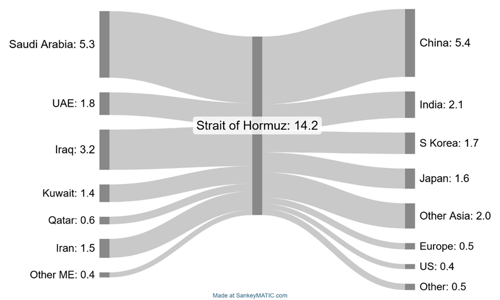
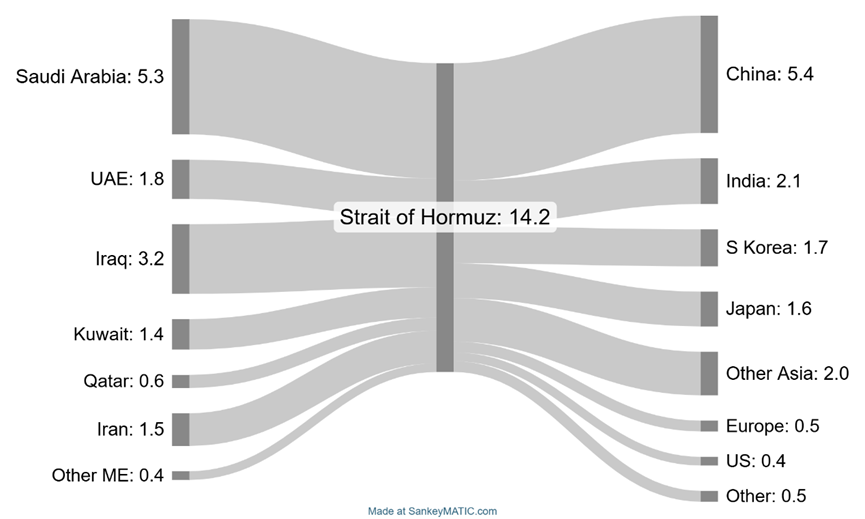
Source: US Energy Information Administration (EIA), Financial Times.
In addition to hydrocarbons, the region is also an important supplier of industrial gases (such as helium[3]) and fertilizer inputs[4], sulphur[5] and petrochemical feedstocks, meaning that prolonged disruption could propagate through several global value chains in electronics[6], food, plastics, paints, metals, chemicals and textiles.
Moreover, freight costs have increased by over 20%, with costs for Middle East routes rising as much as 40.8%[7], which can impact the cost of goods more broadly.
Moreover, freight costs have increased by over 20%, with costs for Middle East routes rising as much as 40.8%[7], which can impact the cost of goods more broadly.
Global macroeconomic impacts of the Iran conflict
The situation in the Middle East remains fluid and the macroeconomic impact is likely to depend on how long the conflict continues and oil and gas trade remains disrupted.
Focusing on the macroeconomic pass-through from oil price rises, estimates from the IMF suggest that a persistent 10% increase in energy prices over a year can raise global inflation by about 0.4 percentage points and reduce global Gross Domestic Product (GDP) growth by 0.1–0.2 percentage points [8].
We consider three illustrative scenarios based on the duration of the conflict, trade disruption and the oil price impact as follows:
- In our baseline scenario of a short-lived disruption, with partial de-escalation of the war within one to two months and oil prices retracing toward pre-war levels, most advanced and larger emerging economies would likely be able to absorb the oil shock using strategic reserves, fiscal measures and targeted price interventions. Under such a scenario, we estimate a modest 0.2-0.3 percentage point reduction in global growth and around 0.3-0.4 percentage point increase in global consumer price inflation (CPI), concentrated in 2026.
- Under our prolonged conflict and high oil-price scenario, with brent crude prices above USD 120/bbl for over six months and ongoing disruptions to Gulf trade, the supply side shock on the global economy becomes more pronounced. In this scenario, we estimate global inflation could rise by 2-3 percentage points and global GDP growth could be lowered by 1–2 percentage points[9], relative to the current baseline GDP growth of 3.3%.
- In an extreme tail risk scenario where oil prices rise to an unprecedented USD 200/bbl, a stagflation-type shock for the global economy could be expected. According to our estimates, a doubling of oil prices could add in the order of 3-4% to global inflation, with central banks likely to follow through by raising interest rates. In this scenario, a >2% reduction in global GDP growth is plausible and could involve several economies with large oil dependencies going into a recession.
Within this global backdrop, the impact on global economies is expected to be uneven.
The impact on Middle East economies would likely be severe, as physical damage to energy and transport infrastructure, disruptions to production and exports, and a sharp fall in tourism and investment would be expected weigh heavily on activity.
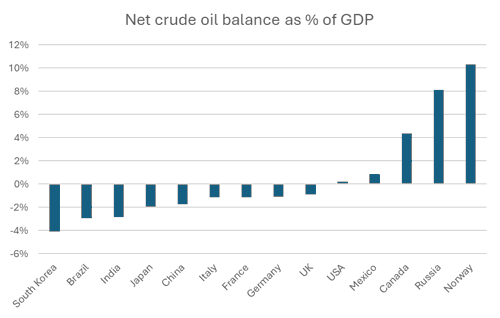
Outside of the region, the economic impact is likely dependent on individual economies’ energy balance (Figure 2)
Major European economies – including Germany, France, Italy, UK - are net energy importers, although overall less reliant on Gulf oil and gas supply. The macroeconomic impact on the region is expected to be less severe than the Russia-related oil and gas price shock in 2022. Estimates suggest a 50% oil price increase sustained for several months could raise euro area headline inflation by around 1–1.5 percentage points and core inflation by about 0.5 percentage points [10], while we estimate that GDP growth for the Euro area could likely stagnate in this case.
The United States is a small net energy exporter and not dependent on Middle East oil or gas, but global prices still determine domestic fuel costs. US gasoline prices have risen by roughly 30% to around USD 3.8–3.9 per gallon from about USD 2.9 a month earlier[11], which could eat into household real incomes and business margins. Estimates from the Federal Reserve suggest a 10% increase in oil prices tends to raise headline inflation by 0.15 percentage points and shave around 0.1 percentage points from US GDP growth over the year[12], suggesting that the US economy may be less sensitive to oil price shocks.
The United States is a small net energy exporter and not dependent on Middle East oil or gas, but global prices still determine domestic fuel costs. US gasoline prices have risen by roughly 30% to around USD 3.8–3.9 per gallon from about USD 2.9 a month earlier[11], which could eat into household real incomes and business margins. Estimates from the Federal Reserve suggest a 10% increase in oil prices tends to raise headline inflation by 0.15 percentage points and shave around 0.1 percentage points from US GDP growth over the year[12], suggesting that the US economy may be less sensitive to oil price shocks.
Figure 2: Net crude oil balance as % of GDP for some major economies
Source: IEA, Worldometer.
Net crude oil balance is calculated as Crude oil production (in million barrels/day) – domestic consumption (in million barrels/day)/ GDP x 100. Middle East countries are excluded for the purposes of this chart.
Net crude oil balance is calculated as Crude oil production (in million barrels/day) – domestic consumption (in million barrels/day)/ GDP x 100. Middle East countries are excluded for the purposes of this chart.
On the other hand, major non-Gulf energy exporters, particularly Norway, Russia and Canada, stand to benefit from higher oil prices and some re-routing of oil demand, although this is likely to be partly offset by weaker global growth.
Asia’s exposure: energy dependence, policy and reserve buffers differentiate economies’ vulnerability to the oil shock
While Asia receives the bulk of oil and gas imports from the Middle East– the macroeconomic impact for economies depends on a few factors – including the economies’ energy mix, energy import dependence, energy intensity, availability of strategic reserves and import alternatives, and how quickly global prices feed-through to the local economy considering government policies.
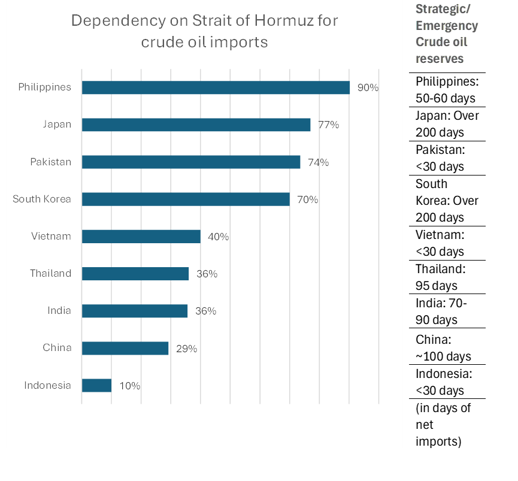
For example, China is the largest buyer of Middle Eastern crude oil, yet Gulf supplies account for only about 40% of its total crude imports and less than 30% of total oil demand once domestic production is included (Figure 3). China’s strategic crude reserves, estimated at roughly 100 days of net imports, and its diversified supplier base (including Russia, Brazil and others) provide meaningful buffers. This, combined with the government’s willingness to manage domestic prices using fiscal tools, makes the Chinese economy relatively less vulnerable to a transient oil shock than many regional peers.
Japan and South Korea import almost all of their crude oil, with a significant 70-80% transiting via the Strait of Hormuz. However, both maintain large strategic oil reserves, exceeding 200 days of consumption, which can be deployed to smooth domestic supply and prices. Moreover, both governments have announced fuel price caps [13],[14], as an emergency measure, delaying the feed-through to consumer prices. Both economies also import almost all their natural gas requirements but are less reliant on the Middle East trade for these. With a more diversified import mix, only about 6% of Japan’s LNG and 17% for South Korea transit via the Strait.
The Indian economy is moderately vulnerable to the conflict. While India has diversified its crude oil imports, it is dependent on the Strait for 60% of its LNG imports, often used as cooking fuel by households. A transitory shock is likely to be absorbed via government subsidies and emergency funds.
However, in the prolonged scenario, the pressure on the current account balances from a higher oil import bill combined with a potential decline in remittances from the Middle East and reduced exports to the region could contribute to weakening the currency, raising costs for all imports. Calculations from India’s Chief Economic Advisor [15] suggest oil prices sustained at USD130/bbl could lower India’s GDP growth by 1% and raise inflation by 3.5%, while a transitory increase in oil prices would likely not have significant macroeconomic impact.
However, in the prolonged scenario, the pressure on the current account balances from a higher oil import bill combined with a potential decline in remittances from the Middle East and reduced exports to the region could contribute to weakening the currency, raising costs for all imports. Calculations from India’s Chief Economic Advisor [15] suggest oil prices sustained at USD130/bbl could lower India’s GDP growth by 1% and raise inflation by 3.5%, while a transitory increase in oil prices would likely not have significant macroeconomic impact.
Figure 3: Asian economies’ exposure to crude oil shock
Reference: Reuters, local media sources, CEIC.
Dependency on Strait of Hormuz is calculated as % of crude oil needs that are imported multiplied by how much of crude oil is imported from Saudi Arabia, UAE, Kuwait, Qatar, Bahrain, Iraq (excludes Oman, as trade from Oman does not need to transit via the Strait of Hormuz, although these flows are still vulnerable to infrastructure damage).
At the more vulnerable end, economies such as the Philippines and Pakistan are heavily dependent on imported oil that transits the Strait (Figure 3), reportedly hold limited strategic oil reserves, and the pass-through of global oil prices to domestic inflation is higher. In countries where public balance sheets are weak, and currencies are vulnerable (for example, Pakistan and Sri Lanka, which are engaged in IMF-supported debt restructuring efforts), a sustained oil price spike and physical shortfalls have the potential to contribute to an inflation surge, currency pressure, and weakening of public sector balance sheets.
Figure 4 summarises CPI headline inflation sensitivity estimates for various economies to a USD10/bbl increase in crude oil prices. Thailand, Pakistan and Philippines tend to have a faster pass-through from global oil prices to consumer price inflation, while China and Indonesia have lower sensitivities given government measures on domestic pass-through of global oil prices.
Figure 4: CPI inflation sensitivity to USD 10/bbl increase in crude oil prices
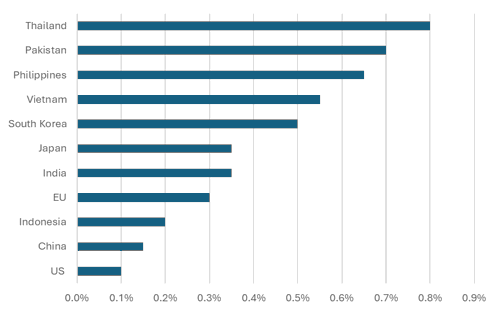
Source: Author estimates based on IMF, OECD NiGEM models, MUFG and ING Research
Re/insurance market implications (selected lines)
For reinsurers, the conflict has a few layers to consider: (1) direct war related exposures, which are usually largely excluded or tightly written, (2) indirect physical damage and business interruption losses along global supply chains, and (3) wider macroeconomic impacts and implications for credit risk.
Property: inflation, accumulation and contingent BI: Most direct war and terrorism losses in the Gulf are likely to fall under specialised political violence/war covers rather than standard property policies, but there could be some uncertainties where strikes on infrastructure (ports, refineries, industrial clusters) could interact with “all risks” wordings and contingent BI.
However, in case of a prolonged conflict, higher energy, freight and industrial input costs could mean further upward pressure on construction and repair costs, reinforcing the high inflation - claims severity linkage in place since 2021-2022.
Trade credit: In a limited/short lived conflict scenario, trade credit risks would likely remain manageable, with credit insurers able to stay nimble by adjusting indemnity ratios, buyer limits and pricing, for instance. However, in the scenario where the war and related energy and logistics disruptions persist for several months, GDP growth is likely to slow, albeit unevenly across global economies and sectors. Such an environment could possibly see higher corporate insolvency rates, especially in energy import dependent markets, thinly capitalised SMEs, and in low margin or leveraged sectors that rely heavily on oil, gas and other inputs from the Middle East; such as transport, aviation, logistics, chemicals, metals and manufacturing.
Some governments are already considering measures to cushion credit risk– for example, Indian authorities have reportedly discussed export relief, similar to COVID-19-era support, including more flexible overdraft rules and moratorium on loan repayments to help soften the impact on exporters and banks [16].
Some governments are already considering measures to cushion credit risk– for example, Indian authorities have reportedly discussed export relief, similar to COVID-19-era support, including more flexible overdraft rules and moratorium on loan repayments to help soften the impact on exporters and banks [16].
In a more adverse scenario where global growth slows steeply, by over 2 percentage points, a more pronounced uptick in trade credit and contract frustration claims could emerge, alongside increased stress on sovereign and quasi sovereign obligors in vulnerable emerging markets. Such conditions could prompt re/insurers to review country and sector exposures and to enhance buyer risk monitoring, particularly in highly leveraged and energy intensive sectors.
Summary
The Iran war is first and foremost a conflict with severe human costs, but it also has the potential for a macro financial shock that can be transmitted via a critical energy chokepoint to the global economy.
Oil import dependent Asian economies, particularly those with higher import dependency, limited strategic oil buffers and weaker public balance sheets, are likely to be most exposed to inflation and growth shocks, with knock on implications for sovereign and corporate credit risk.
Oil import dependent Asian economies, particularly those with higher import dependency, limited strategic oil buffers and weaker public balance sheets, are likely to be most exposed to inflation and growth shocks, with knock on implications for sovereign and corporate credit risk.
For re/insurers, the conflict underscores the importance of embedding energy and geopolitics related risks into underwriting, pricing and capital allocation and the importance of exposure mapping across supply chains to identify trade credit and contingent BI risks.
The conflict also highlights the value of dynamic credit and political risks monitoring in line with evolving macro scenarios in order to preserve underwriting resilience and to be able to support clients as the global economy reacts and adapts to the ongoing external shock.
[1] US EIA: Amid regional conflict, the Strait of Hormuz remains critical oil chokepoint, 16 June, 2025
[2] US EIA: About one-fifth of global liquefied natural gas trade flows through the Strait of Hormuz, 24 June, 2025
[3] Reuters: Helium prices soar as Qatar LNG halt exposes fragile supply chain, 12 March 2026
[4] World Economic Forum: Another conflict, another reminder of the fragility of the world’s food supply, 12 March 2026
[5] CNA: Gulf disruption squeezes Indonesia nickel makers' sulphur supply, 6 March, 2026
[6] CNBC: How the Iran war and rising energy prices are threatening semiconductor demand, 10 March, 2026
[7] Seoul Economic Daily: Container Freight Rates Jump 30% Since US-Iran Conflict, 14 March 2026
[8] IMF: Coping and Thriving in a Fluid World: 9 March 2026
[9] Estimates reference IMF elasticity calculations [8], NSIER NiGEM papers and models on the econometric impact from the Russia-Ukraine war, Asian Development Bank note on oil impact on Asia
[10] Institute for Monetary and Financial Stability: Scenarios concerning the possible consequences of the Iran war for Euro Area inflation, Hendrik Hegemann and Volker Wieland, 2026
[11] gasprices.aaa.com
[12] Federal Reserve: Oil Price Shocks and Inflation in a DSGE Model of the Global Economy, Ignacio Presno and Andrea Prestipino, 2 August 2024
[13] The Japan times: Japan to roll out gasoline subsidies amid record-high prices, 18 March 2026
[14] Reuters: South Korea to impose fuel price cap to shield economy from energy shock, 9 March, 2026
[15] Business Line: CEA warns $130 crude could cut India’s GDP growth by 1%, 17 March, 2026
[16] Bloomberg: India plans $6.2bn fund, export relief amid Iran war, 14 March 2026
Disclaimer
Peak Re provides the information contained in this document for general information purposes only. No representation or guarantee is made as to the accuracy, completeness, reasonableness or suitability of this information or any other linked information presented, referenced or implied. All critical information should be independently verified and Peak Re accepts no responsibility or liability for any loss arising or which may arise from reliance on the information provided. All information and/or data contained in this document is provided as of the date of this document and is subject to change without notice. Neither Peak Re nor any of its affiliates accepts any responsibility or liability for any loss caused or occasioned to any person acting or refraining from acting on the basis of any statement, fact, text, graphic, figure or expression of belief contained in this document or communication.
The information is not intended to constitute, and should not be construed as, investment research, financial advice (nor investment, tax, accounting or legal advice), or a recommendation of any kind.
All rights reserved. The information contained in this document is for your information only and no part of this document may be reproduced, stored or transmitted in any form or by any means, electronic, mechanical, photocopying, recording or otherwise, without the prior written permission of Peak Re. Any other information relating to this document, whether verbal, written or in any other form, given by Peak Re either before or after your receipt of this document shall be provided on the same basis as set out in this disclaimer. This document is not intended to constitute advice or recommendation, and should not be relied upon or treated as a substitute for advice or recommendation appropriate to any particular circumstances.
© 2026 Peak Reinsurance Company Limited.
Other Insights

Fri, 26 Jun 2026
| 17 mins
|
Edward Shen +1 more

Wed, 22 Apr 2026
| 16 mins
|
Frankie Chan

Fri, 30 Jan 2026
| 18 mins
|
Kritika Kashyap
Mon, 27 Oct 2025
| 10 mins
|
Kritika Kashyap

Elevate Your Business
with Peak Re
with Peak Re