




Tariff Turbulence: Trade Credit Insurance in an Era of Uncertainty


Head of Credit & Bond

Senior Vice President, Economist
Global trade—the backbone of the world economy—is confronting fresh challenges amid escalating tariffs and rising protectionism. Tariffs are being yielded by governments not only for economic reasons, but also as geopolitical leverage. Driven by concerns ranging from national security to trade balances, this trend appears set to persist, reshaping trade flows and credit risks globally.
For the trade credit insurance (TCI) market, the shifting landscape presents both challenges and opportunities. Understanding the evolving trade dynamics, credit risk implications, and insurer responses are critical to navigating an increasingly complex global risk environment.
The Trade Landscape: Slower Growth and Rising Uncertainty
The World Trade Organization (WTO) projects global merchandise trade growth will slow sharply to 0.9% in 2025 — a notable decline from pre-tariff forecasts of around 2.7%. North America is projected to subtract 0.7% from global trade growth, while Asia, is expected to remain the principal engine for trade growth, despite its slowing contribution[1].
The underpinning story is one of disruption and realignment. The 2018 U.S.-China trade war accelerated diversification away from Chinese exports to other Asian and international markets. Recent tariff announcements drove a strategic frontloading of shipments in the first half of 2025—and would likely steer global trade flows further as the latest round of US tariffs take effect in August.
Moreover, the ripple effect of tariffs go far beyond trade volumes, affecting corporate margins, profitability, and investments. Several corporates across the United States, EMEA, and Japan, have issued profit margin warnings, and announced supply chain changes due to tariffs, in their second quarter earnings announcements [2].
Asia: Resilience Amid Realignment
Despite headwinds, Asia’s trade outlook remains relatively stable. The region is poised to gain from continued supply chain diversification. The Southeast Asian economies, despite receiving an initial shock from the “Liberation Day” tariff announcement, have settled at a relatively moderate US tariff rate of around 19-20% across Thailand, Vietnam, Malaysia, Indonesia and the Philippines, which is moderately higher than the 10-15% lower end of the range of US “reciprocal” tariffs starting in August, but far better than a 50% tariff hitting some emerging market economies like India and Brazil. Southeast Asia also enjoys other competitive advantages like a young labour-force, and established supply chains.
For Taiwan and South Korea, the tech sectors, especially semiconductors, offer tailwinds. Meanwhile, US-China trade negotiations have extended to November 2025, providing a temporary buffer.
That said, the region is not immune to the risk. Many corporates were unprepared for the tariff escalation, while increased regional competition could also squeeze corporate margins and elevate credit risk, especially for the small- scale exporters and manufacturers.
Trade Credit Insurance: A Buffer Against Uncertainty
Trade credit insurance is inherently sensitive to global trade shifts. However, immediate impacts on insurer claims or profitability are not expected. Rather, the real test will lie in how these tariffs may influence trade volumes, costs, corporate profitability, and payment behaviors over time.
Lessons from previous crisis, including the 2008 Global Financial Crisis (GFC), the 2018 US-China trade war, followed by COVID-19 shock, 2022 inflation and Russia-Ukraine war, have all equipped trade credit insurers with agile underwriting and risk management frameworks and quality data, with each crisis lending the industry greater resilience to future shocks. Case in point – between 2019 to 2023, trade credit premiums grew at a CAGR of 14%[3], attributed to a heightened interest in risk mitigation tools in response to supply chain challenges.
Figure 1: Trade credit insurance premiums grew while claims ratio has remained largely stable through multiple recent uncertainties
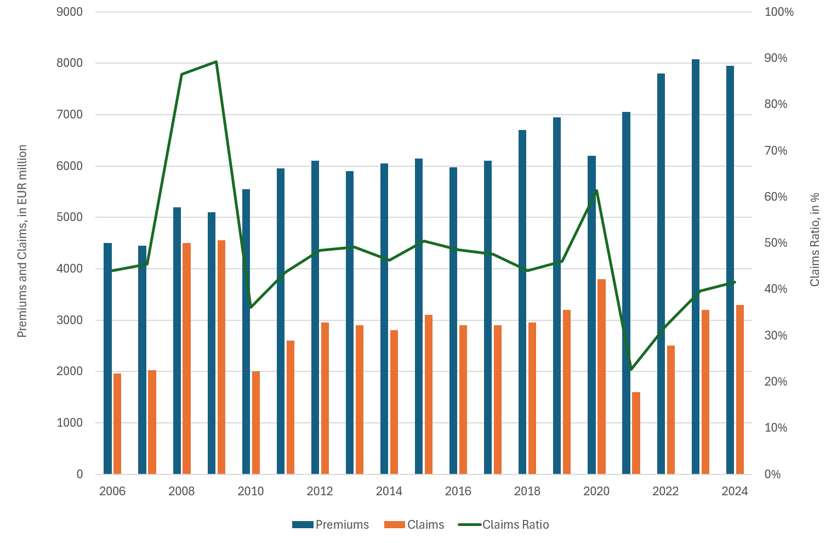
Source: ICISA statistics
Demand for protection may similarly see a tick-up in 2025, led by two key drivers:
Heightened risk-awareness: Unprecedented levels of trade uncertainty are likely to foster greater risk awareness, increasing demand from exporters and banks. The Berne Union’s latest Export Credit Business Confidence Trends Index reveals that nearly 60% of credit and political risk insurers anticipate growth in trade credit coverage over the next 12 months.
Shifting trade risk landscape: New counterparties and continued supply chain diversification into new markets could mean adapting to completely new risk landscapes and risk culture in new jurisdictions - a risk that exporters and banks would look to mitigate.
Lessons from the 2018 US-China trade war for Asia’s Trade Credit Insurance Sector
The US-China trade war and tit-for-tat tariffs in 2018 unsettled supply chains and corporate margins across regions. US-China trade contracted by about USD 60 billion over 2018-19. Estimates by the Federal Reserve Bank of New York showed that US companies exposed to China – about half of US publicly listed companies - experienced profit declines of 13% between 2019-2021[4]. Corporate strain was evident in Asia-Pacific too, with delayed payments and cash flow pressures, especially in China, India, and Singapore[5].
Yet, despite commercial pressures, global trade credit claims did not spike, according to International Credit Insurance & Surety Association (ICISA) data.
Agile limit management, tighter underwriting and shorter tenors in tariff-heavy sectors (such as steel, aluminium), increasing premiums and expanding sales in less-affected markets helped insurers maintain profitability. Government safety nets also supported vulnerable exporters. Overall, net industry results stayed within normal ranges underpinned by diversified portfolios and cautious risk management.
This speaks to the structural resilience of credit insurance - where short policy cycles, dynamic underwriting, constant risk monitoring, diversified portfolios, reinsurance backstops, and recoveries help manage risks through volatile periods.
What Lies Ahead: Challenges and Opportunities for 2025
Looking ahead, while trade and credit risks will likely intensify, the impact should be mitigated by the order frontloading in early-2025.
Insolvency rates are expected to trend higher, but likely only normalising to pre-COVID-19 levels, as government relief measures wind down. Some pockets of the economy are vulnerable - for example, US SMEs could see higher costs from tariffs as well as increased regulatory complexity, while smaller Asian exporters could be edged out by supply-chain shifts and strong regional competition.
Demand for TCI is set to broaden, as more exporters, suppliers, and financial institutions become more risk-aware. At the same time, insurers may exercise more caution, especially in the more tariff-sensitive sectors and geographies.
Overall, the TCI market, remains balanced, given relatively low loss frequency in recent years. Pressure on pricing and claims could rise, but unlikely to significantly impact industry loss ratios.
The agility insurers demonstrated by adapting underwriting policies and product features during the multiple recent shocks, including the 2018-19 trade-wars, shows the resilience and innovation that can serve the sector well going forward.
Ongoing innovation, with AI playing a key role, continues to further enhance resilience. Through improved credit data tracking, risk assessment, and accumulation modeling, AI is likely to enable faster, more efficient credit scoring and pricing decisions.
Conclusion: Building Resilience in a Protectionist Era
Rising tariffs reshape global trade and increase risks, highlighting the vital role of trade credit insurance in uncertain times. Re/insurers stand ready to meet these challenges with analytical rigor, strategic foresight and capital support, sustaining the flow of trade finance vital for economic growth. The industry’s adaptability, agile risk management and innovation are poised to be a sustaining force amidst shifting international trade dynamics.
This article was first published in Re(in) Asia on 29 August 2025.
[1] WTO Trade Forecasts: Frontloading, measured responses cushion tariff impact in 2025 but risk high for 2026, 8 August 2025
[2] Reuters: How companies are responding to Trump’s tariffs, 19 August 2025
[3] ICISA Annual Industry Results: Credit and Surety protection grows in tumultuous 2024, June 2025
[4] Federal Reserve Bank of New York: Liberty Street Economics, Do Import Tariffs Protect US Firms?, 5 December 2024
[5] Coface 2018 Asia Corporate Payment Survey
Disclaimer
Peak Re provides the information contained in this document for general information purposes only. No representation or guarantee is made as to the accuracy, completeness, reasonableness or suitability of this information or any other linked information presented, referenced or implied. All critical information should be independently verified and Peak Re accepts no responsibility or liability for any loss arising or which may arise from reliance on the information provided. All information and/or data contained in this document is provided as of the date of this document and is subject to change without notice. Neither Peak Re nor any of its affiliates accepts any responsibility or liability for any loss caused or occasioned to any person acting or refraining from acting on the basis of any statement, fact, text, graphic, figure or expression of belief contained in this document or communication.
All rights reserved. The information contained in this document is for your information only and no part of this document may be reproduced, stored or transmitted in any form or by any means, electronic, mechanical, photocopying, recording or otherwise, without the prior written permission of Peak Re. Any other information relating to this document, whether verbal, written or in any other form, given by Peak Re either before or after your receipt of this document shall be provided on the same basis as set out in this disclaimer. This document is not intended to constitute advice or recommendation, and should not be relied upon or treated as a substitute for advice or recommendation appropriate to any particular circumstances.
© 2025 Peak Reinsurance Company Limited.
Other Insights

Fri, 26 Jun 2026
| 17 mins
|
Edward Shen +1 more


Wed, 22 Apr 2026
| 16 mins
|
Frankie Chan

Tue, 24 Mar 2026
| 19 mins
|
Kritika Kashyap

Fri, 30 Jan 2026
| 18 mins
|
Kritika Kashyap

Elevate Your Business
with Peak Re
with Peak Re